#include <assert.h>#include <ctype.h>#include <cwalk.h>#include <stdarg.h>#include <stdio.h>#include <string.h>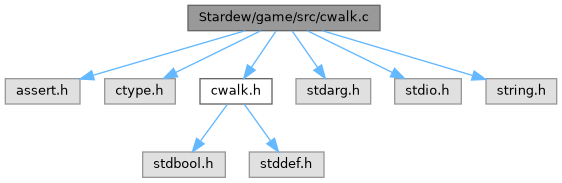
Data Structures | |
| struct | cwk_segment_joined |
Functions | |
| size_t | cwk_path_get_absolute (const char *base, const char *path, char *buffer, size_t buffer_size) |
| Generates an absolute path based on a base. | |
| size_t | cwk_path_get_relative (const char *base_directory, const char *path, char *buffer, size_t buffer_size) |
| Generates a relative path based on a base. | |
| size_t | cwk_path_join (const char *path_a, const char *path_b, char *buffer, size_t buffer_size) |
| Joins two paths together. | |
| size_t | cwk_path_join_multiple (const char **paths, char *buffer, size_t buffer_size) |
| Joins multiple paths together. | |
| void | cwk_path_get_root (const char *path, size_t *length) |
| Determines the root of a path. | |
| size_t | cwk_path_change_root (const char *path, const char *new_root, char *buffer, size_t buffer_size) |
| Changes the root of a path. | |
| bool | cwk_path_is_absolute (const char *path) |
| Determine whether the path is absolute or not. | |
| bool | cwk_path_is_relative (const char *path) |
| Determine whether the path is relative or not. | |
| void | cwk_path_get_basename (const char *path, const char **basename, size_t *length) |
| Gets the basename of a file path. | |
| size_t | cwk_path_change_basename (const char *path, const char *new_basename, char *buffer, size_t buffer_size) |
| Changes the basename of a file path. | |
| void | cwk_path_get_dirname (const char *path, size_t *length) |
| Gets the dirname of a file path. | |
| bool | cwk_path_get_extension (const char *path, const char **extension, size_t *length) |
| Gets the extension of a file path. | |
| bool | cwk_path_has_extension (const char *path) |
| Determines whether the file path has an extension. | |
| size_t | cwk_path_change_extension (const char *path, const char *new_extension, char *buffer, size_t buffer_size) |
| Changes the extension of a file path. | |
| size_t | cwk_path_normalize (const char *path, char *buffer, size_t buffer_size) |
| Creates a normalized version of the path. | |
| size_t | cwk_path_get_intersection (const char *path_base, const char *path_other) |
| Finds common portions in two paths. | |
| bool | cwk_path_get_first_segment (const char *path, struct cwk_segment *segment) |
| Gets the first segment of a path. | |
| bool | cwk_path_get_last_segment (const char *path, struct cwk_segment *segment) |
| Gets the last segment of the path. | |
| bool | cwk_path_get_next_segment (struct cwk_segment *segment) |
| Advances to the next segment. | |
| bool | cwk_path_get_previous_segment (struct cwk_segment *segment) |
| Moves to the previous segment. | |
| enum cwk_segment_type | cwk_path_get_segment_type (const struct cwk_segment *segment) |
| Gets the type of the submitted path segment. | |
| bool | cwk_path_is_separator (const char *str) |
| Checks whether the submitted pointer points to a separator. | |
| size_t | cwk_path_change_segment (struct cwk_segment *segment, const char *value, char *buffer, size_t buffer_size) |
| Changes the content of a segment. | |
| enum cwk_path_style | cwk_path_guess_style (const char *path) |
| Guesses the path style. | |
| void | cwk_path_set_style (enum cwk_path_style style) |
| Configures which path style is used. | |
| enum cwk_path_style | cwk_path_get_style (void) |
| Gets the path style configuration. | |
Function Documentation
◆ cwk_path_change_basename()
| size_t cwk_path_change_basename | ( | const char * | path, |
| const char * | new_basename, | ||
| char * | buffer, | ||
| size_t | buffer_size | ||
| ) |
Changes the basename of a file path.
This function changes the basename of a file path. This function will not write out more than the specified buffer can contain. However, the generated string is always null-terminated - even if not the whole path is written out. The function returns the total number of characters the complete buffer would have, even if it was not written out completely. The path may be the same memory address as the buffer.
- Parameters
-
path The original path which will be used for the modified path. new_basename The new basename which will replace the old one. buffer The buffer where the changed path will be written to. buffer_size The size of the result buffer where the changed path is written to.
- Returns
- Returns the size which the complete new path would have if it was not truncated.
◆ cwk_path_change_extension()
| size_t cwk_path_change_extension | ( | const char * | path, |
| const char * | new_extension, | ||
| char * | buffer, | ||
| size_t | buffer_size | ||
| ) |
Changes the extension of a file path.
This function changes the extension of a file name. The function will append an extension if the basename does not have an extension, or use the extension as a basename if the path does not have a basename. This function will not write out more than the specified buffer can contain. However, the generated string is always null-terminated - even if not the whole path is written out. The function returns the total number of characters the complete buffer would have, even if it was not written out completely. The path may be the same memory address as the buffer.
- Parameters
-
path The path which will be used to make the change. new_extension The extension which will be placed within the new path. buffer The output buffer where the result will be written to. buffer_size The size of the output buffer where the result will be written to.
- Returns
- Returns the total size which the output would have if it was not truncated.
◆ cwk_path_change_root()
| size_t cwk_path_change_root | ( | const char * | path, |
| const char * | new_root, | ||
| char * | buffer, | ||
| size_t | buffer_size | ||
| ) |
Changes the root of a path.
This function changes the root of a path. It does not normalize the result. The result will be written to a buffer, which might be truncated if the buffer is not large enough to hold the full path. However, the truncated result will always be null-terminated. The returned value is the amount of characters which the resulting path would take if it was not truncated (excluding the null-terminating character).
- Parameters
-
path The original path which will get a new root. new_root The new root which will be placed in the path. buffer The output buffer where the result is written to. buffer_size The size of the output buffer where the result is written to.
- Returns
- Returns the total amount of characters of the new path.
◆ cwk_path_change_segment()
| size_t cwk_path_change_segment | ( | struct cwk_segment * | segment, |
| const char * | value, | ||
| char * | buffer, | ||
| size_t | buffer_size | ||
| ) |
Changes the content of a segment.
This function overrides the content of a segment to the submitted value and outputs the whole new path to the submitted buffer. The result might require less or more space than before if the new value length differs from the original length. The output is truncated if the new path is larger than the submitted buffer size, but it is always null-terminated. The source of the segment and the submitted buffer may be the same.
- Parameters
-
segment The segment which will be modifier. value The new content of the segment. buffer The buffer where the modified path will be written to. buffer_size The size of the output buffer.
- Returns
- Returns the total size which would have been written if the output was not truncated.
◆ cwk_path_get_absolute()
| size_t cwk_path_get_absolute | ( | const char * | base, |
| const char * | path, | ||
| char * | buffer, | ||
| size_t | buffer_size | ||
| ) |
Generates an absolute path based on a base.
This function generates an absolute path based on a base path and another path. It is guaranteed to return an absolute path. If the second submitted path is absolute, it will override the base path. The result will be written to a buffer, which might be truncated if the buffer is not large enough to hold the full path. However, the truncated result will always be null-terminated. The returned value is the amount of characters which the resulting path would take if it was not truncated (excluding the null-terminating character).
- Parameters
-
base The absolute base path on which the relative path will be applied. path The relative path which will be applied on the base path. buffer The buffer where the result will be written to. buffer_size The size of the result buffer.
- Returns
- Returns the total amount of characters of the new absolute path.
◆ cwk_path_get_basename()
| void cwk_path_get_basename | ( | const char * | path, |
| const char ** | basename, | ||
| size_t * | length | ||
| ) |
Gets the basename of a file path.
This function gets the basename of a file path. A pointer to the beginning of the basename will be returned through the basename parameter. This pointer will be positioned on the first letter after the separator. The length of the file path will be returned through the length parameter. The length will be set to zero and the basename to NULL if there is no basename available.
- Parameters
-
path The path which will be inspected. basename The output of the basename pointer. length The output of the length of the basename. This may be null if not required.
◆ cwk_path_get_dirname()
| void cwk_path_get_dirname | ( | const char * | path, |
| size_t * | length | ||
| ) |
Gets the dirname of a file path.
This function determines the dirname of a file path and returns the length up to which character is considered to be part of it. If no dirname is found, the length will be set to zero. The beginning of the dirname is always equal to the submitted path pointer.
- Parameters
-
path The path which will be inspected. length The length of the dirname.
◆ cwk_path_get_extension()
| bool cwk_path_get_extension | ( | const char * | path, |
| const char ** | extension, | ||
| size_t * | length | ||
| ) |
Gets the extension of a file path.
This function extracts the extension portion of a file path. A pointer to the beginning of the extension will be returned through the extension parameter if an extension is found and true is returned. This pointer will be positioned on the dot. The length of the extension name will be returned through the length parameter. If no extension is found both parameters won't be touched and false will be returned.
- Parameters
-
path The path which will be inspected. extension The output of the extension pointer. length The output of the length of the extension.
- Returns
- Returns true if an extension is found or false otherwise.
◆ cwk_path_get_first_segment()
| bool cwk_path_get_first_segment | ( | const char * | path, |
| struct cwk_segment * | segment | ||
| ) |
Gets the first segment of a path.
This function finds the first segment of a path. The position of the segment is set to the first character after the separator, and the length counts all characters until the next separator (excluding the separator).
- Parameters
-
path The path which will be inspected. segment The segment which will be extracted.
- Returns
- Returns true if there is a segment or false if there is none.
◆ cwk_path_get_intersection()
| size_t cwk_path_get_intersection | ( | const char * | path_base, |
| const char * | path_other | ||
| ) |
Finds common portions in two paths.
This function finds common portions in two paths and returns the number characters from the beginning of the base path which are equal to the other path.
- Parameters
-
path_base The base path which will be compared with the other path. path_other The other path which will compared with the base path.
- Returns
- Returns the number of characters which are common in the base path.
◆ cwk_path_get_last_segment()
| bool cwk_path_get_last_segment | ( | const char * | path, |
| struct cwk_segment * | segment | ||
| ) |
Gets the last segment of the path.
This function gets the last segment of a path. This function may return false if the path doesn't contain any segments, in which case the submitted segment parameter is not modified. The position of the segment is set to the first character after the separator, and the length counts all characters until the end of the path (excluding the separator).
- Parameters
-
path The path which will be inspected. segment The segment which will be extracted.
- Returns
- Returns true if there is a segment or false if there is none.
◆ cwk_path_get_next_segment()
| bool cwk_path_get_next_segment | ( | struct cwk_segment * | segment | ) |
Advances to the next segment.
This function advances the current segment to the next segment. If there are no more segments left, the submitted segment structure will stay unchanged and false is returned.
- Parameters
-
segment The current segment which will be advanced to the next one.
- Returns
- Returns true if another segment was found or false otherwise.
◆ cwk_path_get_previous_segment()
| bool cwk_path_get_previous_segment | ( | struct cwk_segment * | segment | ) |
Moves to the previous segment.
This function moves the current segment to the previous segment. If the current segment is the first one, the submitted segment structure will stay unchanged and false is returned.
- Parameters
-
segment The current segment which will be moved to the previous one.
- Returns
- Returns true if there is a segment before this one or false otherwise.
◆ cwk_path_get_relative()
| size_t cwk_path_get_relative | ( | const char * | base_directory, |
| const char * | path, | ||
| char * | buffer, | ||
| size_t | buffer_size | ||
| ) |
Generates a relative path based on a base.
This function generates a relative path based on a base path and another path. It determines how to get to the submitted path, starting from the base directory. The result will be written to a buffer, which might be truncated if the buffer is not large enough to hold the full path. However, the truncated result will always be null-terminated. The returned value is the amount of characters which the resulting path would take if it was not truncated (excluding the null-terminating character).
- Parameters
-
base_directory The base path from which the relative path will start. path The target path where the relative path will point to. buffer The buffer where the result will be written to. buffer_size The size of the result buffer.
- Returns
- Returns the total amount of characters of the full path.
◆ cwk_path_get_root()
| void cwk_path_get_root | ( | const char * | path, |
| size_t * | length | ||
| ) |
Determines the root of a path.
This function determines the root of a path by finding its length. The root always starts at the submitted path. If the path has no root, the length will be set to zero.
- Parameters
-
path The path which will be inspected. length The output of the root length.
◆ cwk_path_get_segment_type()
| enum cwk_segment_type cwk_path_get_segment_type | ( | const struct cwk_segment * | segment | ) |
Gets the type of the submitted path segment.
This function inspects the contents of the segment and determines the type of it. Currently, there are three types CWK_NORMAL, CWK_CURRENT and CWK_BACK. A CWK_NORMAL segment is a normal folder or file entry. A CWK_CURRENT is a "./" and a CWK_BACK a "../" segment.
- Parameters
-
segment The segment which will be inspected.
- Returns
- Returns the type of the segment.
◆ cwk_path_get_style()
| enum cwk_path_style cwk_path_get_style | ( | void | ) |
Gets the path style configuration.
This function gets the style configuration which is currently used for the paths. This configuration determines how paths are parsed and generated.
- Returns
- Returns the current path style configuration.
◆ cwk_path_guess_style()
| enum cwk_path_style cwk_path_guess_style | ( | const char * | path | ) |
Guesses the path style.
This function guesses the path style based on a submitted path-string. The guessing will look at the root and the type of slashes contained in the path and return the style which is more likely used in the path.
- Parameters
-
path The path which will be inspected.
- Returns
- Returns the style which is most likely used for the path.
◆ cwk_path_has_extension()
| bool cwk_path_has_extension | ( | const char * | path | ) |
Determines whether the file path has an extension.
This function determines whether the submitted file path has an extension. This will evaluate to true if the last segment of the path contains a dot.
- Parameters
-
path The path which will be inspected.
- Returns
- Returns true if the path has an extension or false otherwise.
◆ cwk_path_is_absolute()
| bool cwk_path_is_absolute | ( | const char * | path | ) |
Determine whether the path is absolute or not.
This function checks whether the path is an absolute path or not. A path is considered to be absolute if the root ends with a separator.
- Parameters
-
path The path which will be checked.
- Returns
- Returns true if the path is absolute or false otherwise.
◆ cwk_path_is_relative()
| bool cwk_path_is_relative | ( | const char * | path | ) |
Determine whether the path is relative or not.
This function checks whether the path is a relative path or not. A path is considered to be relative if the root does not end with a separator.
- Parameters
-
path The path which will be checked.
- Returns
- Returns true if the path is relative or false otherwise.
◆ cwk_path_is_separator()
| bool cwk_path_is_separator | ( | const char * | str | ) |
Checks whether the submitted pointer points to a separator.
This function simply checks whether the submitted pointer points to a separator, which has to be null-terminated (but not necessarily after the separator). The function will return true if it is a separator, or false otherwise.
- Parameters
-
str A pointer to a string.
- Returns
- Returns true if it is a separator, or false otherwise.
◆ cwk_path_join()
| size_t cwk_path_join | ( | const char * | path_a, |
| const char * | path_b, | ||
| char * | buffer, | ||
| size_t | buffer_size | ||
| ) |
Joins two paths together.
This function generates a new path by combining the two submitted paths. It will remove double separators, and unlike cwk_path_get_absolute it permits the use of two relative paths to combine. The result will be written to a buffer, which might be truncated if the buffer is not large enough to hold the full path. However, the truncated result will always be null-terminated. The returned value is the amount of characters which the resulting path would take if it was not truncated (excluding the null-terminating character).
- Parameters
-
path_a The first path which comes first. path_b The second path which comes after the first. buffer The buffer where the result will be written to. buffer_size The size of the result buffer.
- Returns
- Returns the total amount of characters of the full, combined path.
◆ cwk_path_join_multiple()
| size_t cwk_path_join_multiple | ( | const char ** | paths, |
| char * | buffer, | ||
| size_t | buffer_size | ||
| ) |
Joins multiple paths together.
This function generates a new path by joining multiple paths together. It will remove double separators, and unlike cwk_path_get_absolute it permits the use of multiple relative paths to combine. The last path of the submitted string array must be set to NULL. The result will be written to a buffer, which might be truncated if the buffer is not large enough to hold the full path. However, the truncated result will always be null-terminated. The returned value is the amount of characters which the resulting path would take if it was not truncated (excluding the null-terminating character).
- Parameters
-
paths An array of paths which will be joined. buffer The buffer where the result will be written to. buffer_size The size of the result buffer.
- Returns
- Returns the total amount of characters of the full, combined path.
◆ cwk_path_normalize()
| size_t cwk_path_normalize | ( | const char * | path, |
| char * | buffer, | ||
| size_t | buffer_size | ||
| ) |
Creates a normalized version of the path.
This function creates a normalized version of the path within the specified buffer. This function will not write out more than the specified buffer can contain. However, the generated string is always null-terminated - even if not the whole path is written out. The returned value is the amount of characters which the resulting path would take if it was not truncated (excluding the null-terminating character). The path may be the same memory address as the buffer.
The following will be true for the normalized path: 1) "../" will be resolved. 2) "./" will be removed. 3) double separators will be fixed with a single separator. 4) separator suffixes will be removed.
- Parameters
-
path The path which will be normalized. buffer The buffer where the new path is written to. buffer_size The size of the buffer.
- Returns
- The size which the complete normalized path has if it was not truncated.
◆ cwk_path_set_style()
| void cwk_path_set_style | ( | enum cwk_path_style | style | ) |
Configures which path style is used.
This function configures which path style is used. The following styles are currently supported.
CWK_STYLE_WINDOWS: Use backslashes as a separator and volume for the root. CWK_STYLE_UNIX: Use slashes as a separator and a slash for the root.
- Parameters
-
style The style which will be used from now on.